

Let's cut to the chase. Your employees are probably checking their phones, thinking about their to-do lists, or mentally planning lunch during your training sessions. And honestly? That's not entirely their fault.
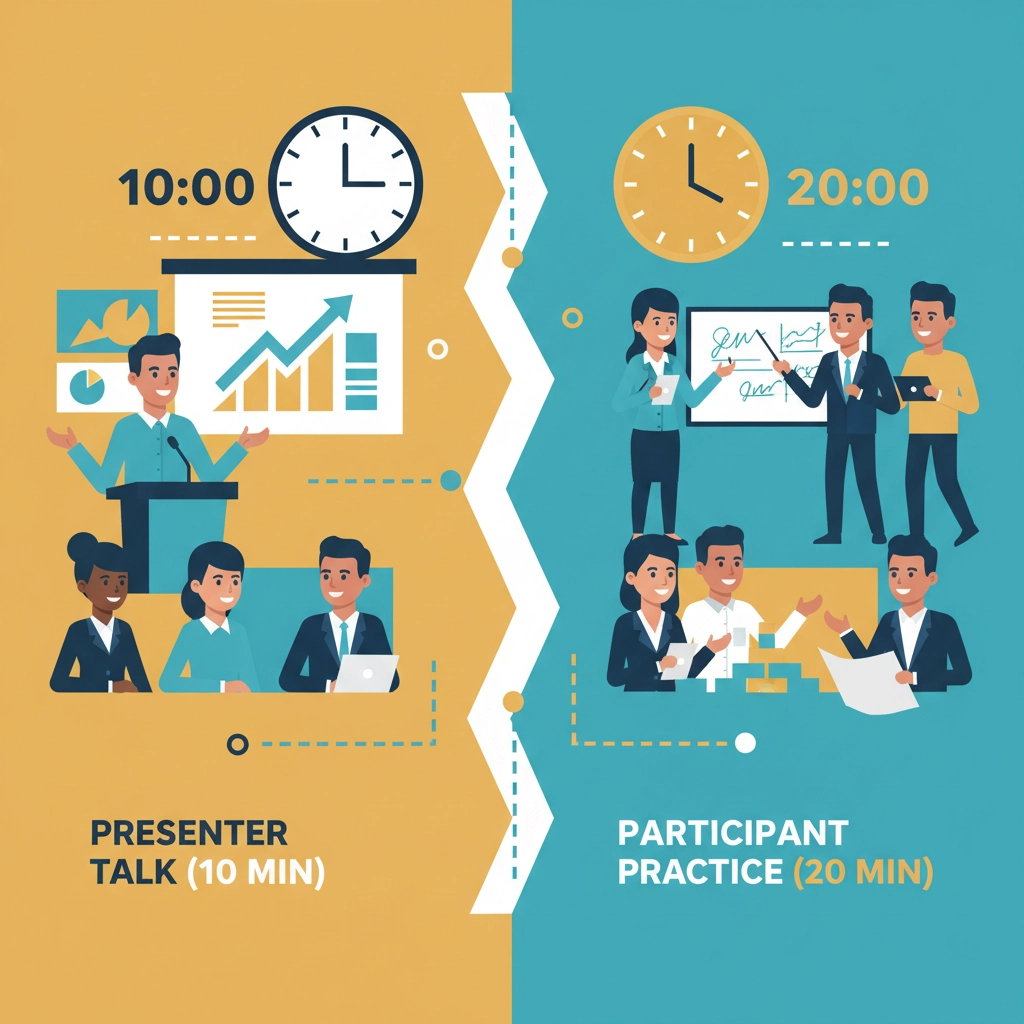
Here's the simple trick that can turn things around immediately: the 10-20 rule. For every 10 minutes you spend teaching or presenting, give your learners 20 minutes to interact, discuss, practice, or apply what they just learned. That's it. This one change can transform your training from a snoozefest into something people actually want to participate in.
But let's dive deeper into why this works and what else you can do right now to boost engagement.
Why Traditional Training Falls Flat
Most training still follows the old "sit and listen" model. Someone talks at people for an hour, maybe throws in a few slides, asks "any questions?" at the end, and calls it a day. The problem? Our brains aren't wired to absorb information that way.
Think about it. When you're learning something new outside of work – like cooking a recipe or figuring out a new app – you don't just read about it for an hour. You try it, mess it up, ask questions, try again. That's how real learning happens.

Start Strong, Right From the Beginning
Your first five minutes determine whether people will mentally check out or stay engaged for the whole session. Skip the boring agenda slides and company overview. Instead, start with a question that makes people think.
Try something like: "Raise your hand if you've ever sat through training and wondered why you were there." You'll probably see a lot of hands go up, and suddenly everyone's paying attention because you just acknowledged what they're all thinking.
Or ask: "What's one thing you hope to get out of this session that will actually help you do your job better?" This immediately shifts the focus from what you want to teach to what they need to learn.
Make Every Minute Count
Here's a truth bomb: if something in your training doesn't directly help people do their jobs better, cut it out. Seriously. Your learners can smell irrelevant content from a mile away, and it's engagement kryptonite.
Before you include any topic, ask yourself: "When will someone actually use this information?" If you can't give a specific, realistic answer, it doesn't belong in your training.
This doesn't mean dumbing things down. It means respecting people's time and intelligence by focusing on what actually matters to them.

The Magic of the 10-20 Rule in Action
Let's say you're teaching people how to handle difficult customer complaints. Instead of talking for 30 minutes about de-escalation techniques, try this:
- Minutes 1-10: Explain one key de-escalation technique
- Minutes 11-30: Have people practice it in pairs, with one person playing the angry customer and the other practicing the technique
- Minutes 31-40: Quick debrief – what worked, what didn't?
- Minutes 41-50: Another 10 minutes of instruction on a different technique
- Minutes 51-70: More practice, maybe with different scenarios
See the difference? People are actively doing something for most of the session, not just listening.
Get People Moving and Talking
Physical movement and social interaction are engagement gold. When people sit in the same position for too long, their brains literally start shutting down. But you don't need to turn your training into aerobics class.
Simple changes work wonders:
- Have people turn to the person next to them and discuss a question for two minutes
- Ask people to stand up and move to different corners of the room based on their answers to a poll
- Use small group activities where people have to work together to solve a problem
- Let people write their ideas on sticky notes and post them on the wall
The key is breaking up the "sit and listen" pattern every 10-15 minutes.
Add Some Friendly Competition
Gamification doesn't have to mean complex point systems or fancy apps. Sometimes the simplest approaches work best.
Try dividing your group into teams and having them compete to come up with the most creative solutions to workplace scenarios. Or create a quick quiz where teams earn points for correct answers. Even something as simple as "Let's see which table can come up with the most examples of this concept" gets people engaged and thinking.
The competitive element taps into something most people naturally enjoy, and it makes the learning feel less like work and more like play.
Create Psychological Safety
Here's something often overlooked: people won't engage if they're worried about looking stupid. You need to create an environment where it's safe to ask questions, make mistakes, and admit when you don't understand something.
Set the tone early by sharing your own learning struggles or admitting when you don't know something. Show that questions are welcome, not interruptions. When someone gives a wrong answer, find something positive in it before providing the correct information.
One simple technique: when someone asks a question, say "That's a great question" before answering it. This encourages others to speak up too.
Make It Stick with Real-World Application
The best training doesn't end when people walk out the door. Build in opportunities for people to apply what they've learned immediately.
Give people specific homework – not busywork, but actual opportunities to practice the new skills in their real jobs. Follow up with them in a week or two to see how it went. Create peer partnerships where people can support each other as they implement new techniques.
When people know they'll be using these skills right away, they pay attention differently during the training.
Technology as a Tool, Not a Crutch
Yes, there are great tech tools that can boost engagement. Interactive polling apps, virtual reality simulations, mobile learning platforms – they all have their place.
But don't fall into the trap of thinking technology alone will solve engagement problems. A boring presentation doesn't become engaging just because you put it on a tablet. The fundamental principles – interaction, relevance, participation – still apply whether you're using cutting-edge VR or just flipchart paper.

Small Changes, Big Results
The beauty of the 10-20 rule and these other techniques is that you can implement them immediately, in your next training session. You don't need approval for a big budget or months of planning. You just need to shift from thinking about training as information delivery to thinking about it as guided practice.
Start with one or two changes. Maybe implement the 10-20 rule in your next session. Or begin with a provocative question instead of an agenda slide. Try having people discuss ideas in pairs for five minutes instead of asking the whole group "any questions?"
Pay attention to the energy in the room. You'll probably notice people sitting up straighter, checking their phones less, and actually participating in discussions instead of staying silent.
The Bottom Line
Engaging training isn't rocket science, but it does require intentional design. It means putting learners at the center of the experience instead of making them passive recipients of information.
The simple trick – that 10-20 rule – is really just the beginning. It's about recognizing that people learn by doing, not just by listening. When you give people opportunities to practice, discuss, and apply new ideas during the training itself, you're not just boosting engagement in the moment. You're making it more likely that they'll actually use what they've learned when they get back to work.
And isn't that the whole point?
Ready to transform your training approach? At ABK Learning Solutions, we help organizations create engaging learning experiences that people actually want to participate in. Because when learning is engaging, everyone wins.