
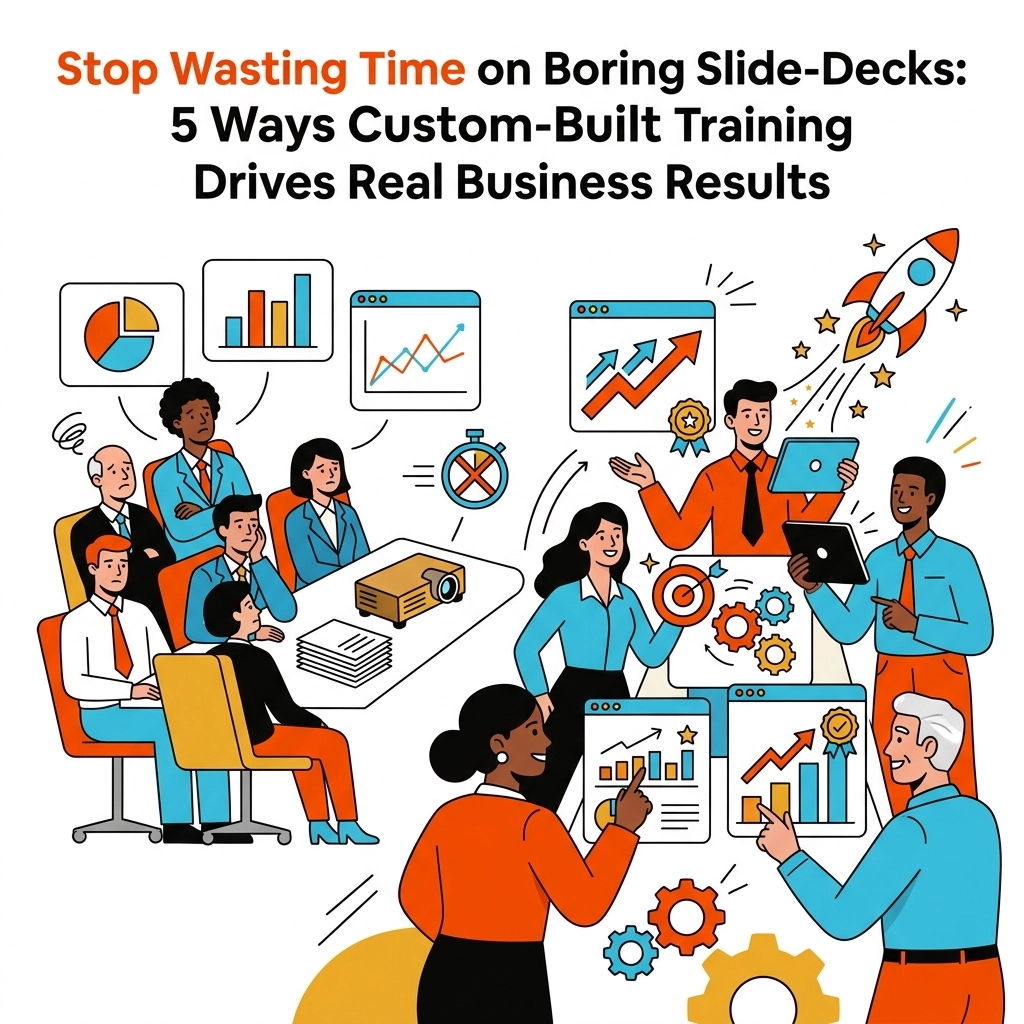
If your “training” is basically a slide-deck with a quiz at the end, you’re not alone. It’s the fastest way to check a compliance box, and also the fastest way to lose learners’ attention (and your budget).
Here’s the problem: boring slide-decks don’t usually change behavior. They might transfer information, but they rarely build job-ready skills. And if the goal is better performance, fewer mistakes, faster onboarding, safer workplaces, or more consistent customer experiences, you need training that’s built for how people actually work.
At ABK Learning Solutions, we design custom eLearning and instructor-led experiences that are tied directly to business outcomes. That means less “nice-to-know,” more “do-this-on-the-job-tomorrow.”
Below are five ways custom-built training drives real business results, plus what to look for if you’re ready to move beyond generic content.
1) It aligns training with the business goals you actually care about
Slide-decks often start with content. Custom training starts with outcomes.
Before we build anything, we ask questions like:
- What do you need people to do differently after this?
- What’s the cost of the current problem (errors, rework, slow ramp-up, safety issues, missed sales, customer complaints)?
- Who’s the audience and what’s happening in their real work environment?
- What does “good” look like, and how will you measure it?
When training is aligned to a real goal, the course structure gets simpler and more useful. The learner doesn’t need five background-history slides. They need practice with the decisions they’ll face this week.
What this looks like in practice
- A manager-training program designed around coaching conversations and feedback moments, not leadership theory.
- A systems-training module that focuses on the 10 workflows employees use daily, not every button in the software.
- A customer-service course that drills the specific scenarios causing escalations, not generic “be polite” reminders.
If you’re measuring success by completion rates, custom training helps you shift to metrics that matter: fewer errors, faster proficiency, higher adoption, improved consistency, better customer satisfaction, and stronger performance.
If you want to see what a solid instructional-design approach looks like end-to-end, ABK Learning Solutions’ process is rooted in exactly this kind of outcome-first thinking: https://abklearningsolutions.com/instructional-design
2) It boosts performance by teaching skills, not just information
Most slide-deck training is passive. Read this. Click Next. Answer a few questions. Done.
But on the job, people don’t get multiple-choice prompts. They get messy situations, time pressure, and unclear choices.
Custom-built eLearning lets you teach the skill in a way that mirrors real work, such as:
- Scenario-based decision-making (choose what you’d do, see the impact)
- Branching conversations for managers, HR, sales, and customer-facing roles
- Software simulations for systems and tools (practice without breaking anything)
- Drag-and-drop sorting activities for categorization and process steps
- Guided practice with feedback that explains the “why,” not just right/wrong
When learners practice realistic tasks, performance improves because the training is closer to the actual job. It’s not entertainment for entertainment’s sake, it’s a controlled practice environment that reduces the “figure it out live” phase.

Quick gut-check: If someone can pass your training but still can’t do the job task confidently, the training is teaching information, not performance.
3) It improves retention because it feels relevant (and shortens seat-time)
People remember what they can use. They forget what feels disconnected.
Custom training improves retention in a few simple ways:
It uses the learner’s language
Internal tools, policies, customer types, and real terminology matter. Generic courses often miss the mark, which creates confusion and eye-rolling. Custom training speaks in the same words people hear every day.
It focuses only on what’s needed
When training is aligned to a job task, you can cut the fluff. That usually means:
- fewer slides
- fewer definitions
- fewer “just in case” tangents
…and more time spent practicing what matters.
It delivers content in the right format
Not every topic needs a 45-minute course. Sometimes microlearning is the better fit: quick, focused modules that support performance in the flow of work (especially for refreshers, updates, or high-frequency tasks).
If you’re exploring shorter modules, performance support, or a “learn it in 5 minutes” approach, ABK Learning Solutions offers microlearning options here: https://abklearningsolutions.com/microlearning
A practical approach we like: use microlearning for “need-to-know-now” tasks and a longer course only when you truly need deeper practice and assessment.
4) It increases ROI by cutting wasted time and targeting the real gaps
Let’s be honest: training budgets get judged fast. If leaders don’t see impact, training becomes an easy target.
Custom eLearning protects ROI by making sure you’re paying for the parts that move the needle:
- Content is built around your most common errors, risks, or performance bottlenecks.
- Seat-time drops because you remove irrelevant content.
- Learners spend time practicing the decisions they’ll actually make.
- Managers get fewer “how do I…” questions after training because the course answered the right ones.
And ROI isn’t just about money saved. It’s also about speed. Faster onboarding, faster tool adoption, faster time-to-competency, and fewer mistakes all add up.
Where custom training often pays off quickly
- Onboarding programs with high turnover or rapid hiring cycles
- Compliance topics where mistakes are expensive (financial, legal, safety)
- New process rollouts where inconsistent adoption kills the initiative
- Customer-facing teams where small behavior changes affect satisfaction and retention
If you’re currently using a slide-deck because it was “quick,” it may be costing more time than it saves.
5) It improves employee satisfaction and retention (because it respects their time)
Employees can tell when training is a checkbox.
They can also tell when it’s meant to help them succeed.
Custom training signals: “We built this for you, for your role, for the real situations you deal with.” That matters more than most people think, especially for teams who feel like training is something happening to them instead of for them.
Here’s what tends to increase satisfaction:
- training that’s clearly relevant
- training that’s well-designed and easy to navigate
- realistic examples instead of vague generalities
- less time wasted on content they already know
- accessible design so everyone can participate fully
And yes, accessibility is part of good training design. If your organization is aiming for Section 508 alignment or simply wants training that works for more learners, ABK Learning Solutions has a helpful resource here: https://abklearningsolutions.com/introduction-to-accessibility-and-section-508
Bottom line: better training experiences support better culture. People are more likely to stick around when they feel supported and set up to succeed.
What “custom-built” actually means (and what it doesn’t)
“Custom” shouldn’t mean “we put your logo on a template and call it done.”
At ABK Learning Solutions, custom-built training typically includes a mix of:
- Instructional design (audience, outcomes, structure, practice, assessment)
- Visual design aligned to your brand and clarity-first layouts
- Storyline development (interactive modules built for real engagement)
- Scenario design and writing that matches your policies and tone
- Multimodal delivery options, like ILT-VILT support when live practice matters
Custom also doesn’t have to mean slow. A lot depends on scope, review cycles, and how quickly we can get the right inputs (SME time, existing materials, examples, policies). The goal is to build what you need without dragging the project out.

A simple checklist: when slide-decks are fine vs. when you need custom eLearning
A slide-deck might be enough if:
- It’s a quick update (schedule change, minor policy tweak)
- The topic is low-risk and low-complexity
- You only need awareness, not behavior change
- You have a live facilitator who can add practice and coaching
You probably need custom-built training if:
- Mistakes are costly (safety, compliance, customer impact, financial risk)
- People keep asking the same questions after training
- You need consistent delivery across teams, locations, or shifts
- You’re rolling out a new system, process, or strategic change
- You want measurable performance improvement, not just completion
If you’re in the middle, a blended approach often works best: some ILT-VILT for live discussion and role-play, plus short eLearning modules for practice and reinforcement. ABK Learning Solutions supports ILT-VILT design too: https://abklearningsolutions.com/ilt-vilt
How ABK Learning Solutions approaches custom training (without overcomplicating it)
Custom training works when it’s built like a performance tool, not a content dump. Our approach is straightforward:
- Clarify the business goal and the performance problem
- Define observable behaviors (what people must do on the job)
- Design practice first (scenarios, simulations, decision points)
- Build in Storyline for interactivity where it adds value
- Measure what matters (not just “did they finish?”)
That’s how you go from “We delivered training” to “We solved a business problem.”
If you’re curious what that could look like for your team, you can explore ABK Learning Solutions’ eLearning services here: https://abklearningsolutions.com/e-learning
Want to replace a slide-deck with training that actually changes behavior?
You don’t have to rebuild everything at once. A smart first step is choosing one high-impact topic (onboarding, a common error, a manager skill gap, a process rollout) and rebuilding that into a short, interactive module with realistic practice.
If you’re ready to talk through what to convert, what to keep, and what outcomes you want, reach out here: https://abklearningsolutions.com/contact